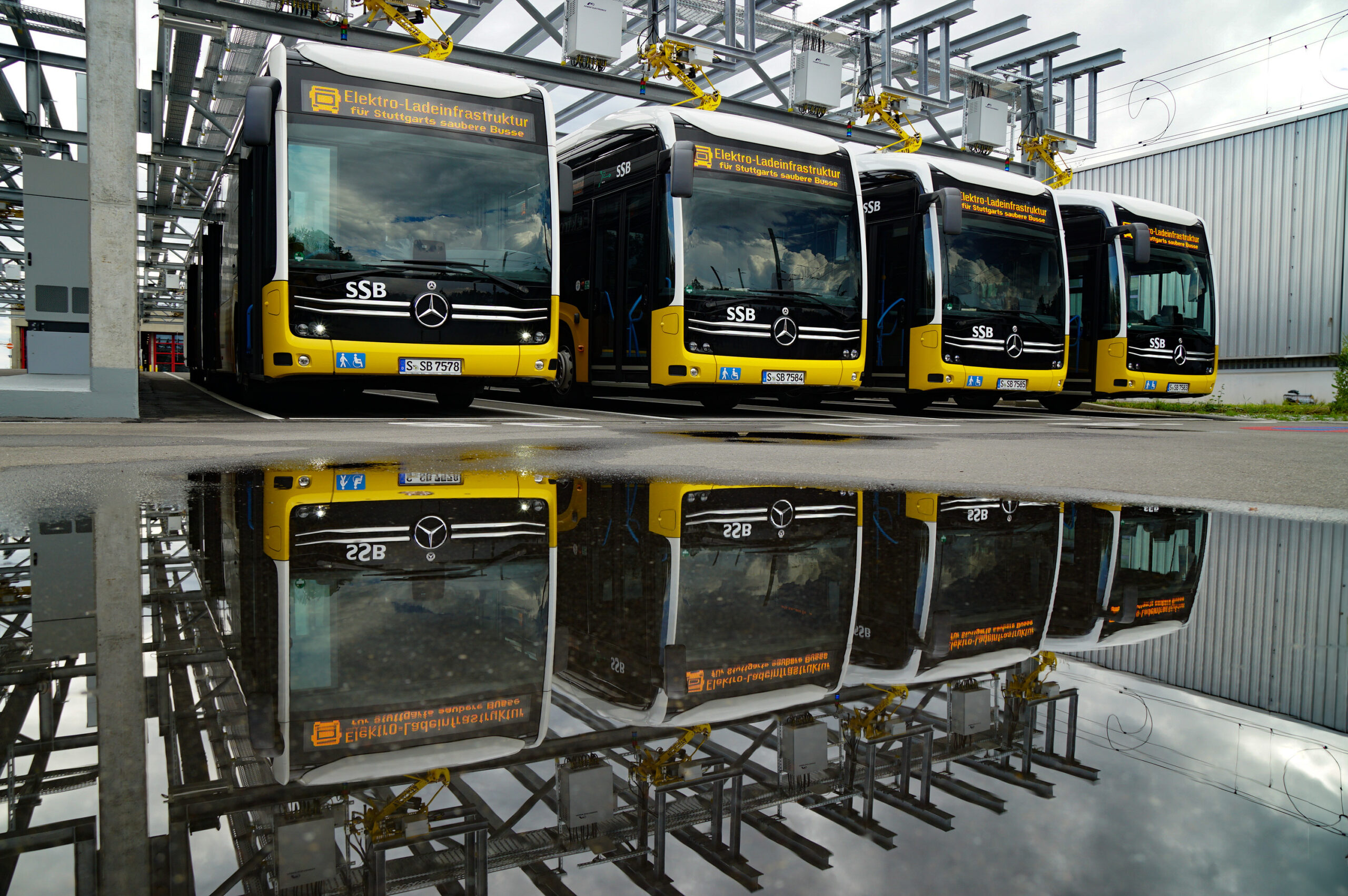
Daimler Buses has installed an electric bus charging system at Stuttgarter Straßenbahnen’s (SSB) Stuttgart-Möhringen depot.
The facility, officially opened on 4 September, includes 28 charging points with pantographs, each with a capacity of up to 180 kW.
The project was carried out by Daimler Buses as general contractor, working with Daimler Buses Solutions and partners Omexom and Power Electronics. The State of Baden-Württemberg contributed approximately 13 million USD in funding through the German State Municipal Transport Financing Act (LGVFG).
Till Oberwörder, CEO of Daimler Buses said:The construction of the charging infrastructure for SSB in the immediate vicinity of our company headquarters here in Stuttgart-Möhringen is something special for us. With our complete package of charging points, electric buses and services, we are supporting SSB in advancing the electrification of local public transport in our metropolitan region, and thus becoming a role model for public transport operators in many other cities.
SSB currently operates 20 Mercedes-Benz eCitaro G articulated buses and eCitaro G fuel cell buses, all equipped with the latest NMC3 battery technology. A further 43 solo and articulated buses, including models with the new NMC4 batteries, will be delivered by Daimler Buses in stages until October 2026.
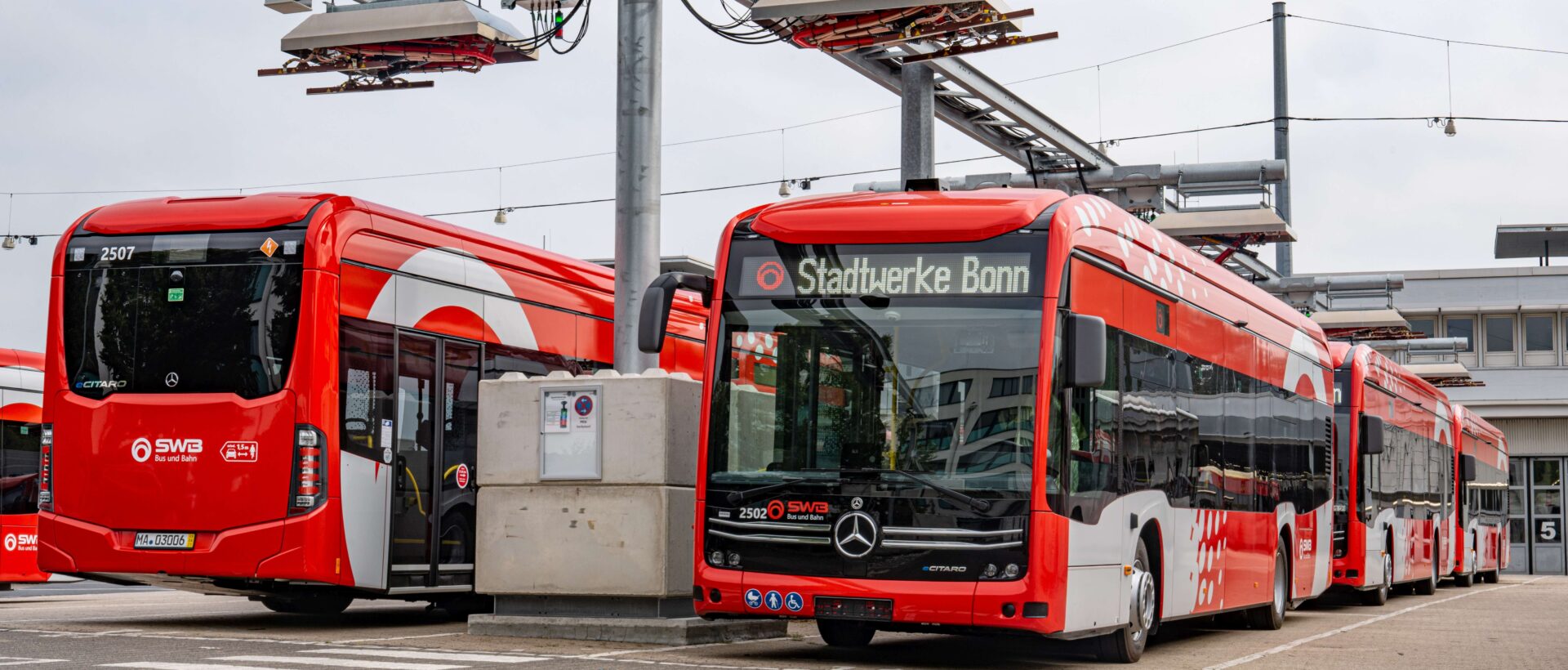
The Möhringen facility enables simultaneous overnight charging of up to 28 buses, with additional capacity for daytime charging. Charging is carried out using a ‘panto down’ process, where pantographs integrated into the charging frame connect with rails on the bus roof.
The eCitaro G articulated buses have up to 686 kWh of battery storage, while the eCitaro G fuel cell buses combine four NMC3 battery packs (392 kWh) with six hydrogen tanks, enabling a range of around 200 kilometres without recharging.
Daimler Buses’ contract covered the full scope of the project, including steelwork, electrical installation and integration of the Sinos charging management system. The agreement also includes a three-year service and maintenance contract with a 24/7 hotline, spare parts supply and annual safety checks in line with German regulations.
Meanwhile, work is also under way at SSB’s Gaisburg depot, where Daimler Buses is installing 37 additional charging points – 33 with inverted pantographs and four with CCS2 plug-in connections. The first stage of this facility is expected to enter service in late autumn 2025. Once both depots are complete, SSB will be able to charge up to 65 buses overnight.
SSB aims to transition all city centre routes to emission-reduced electric buses by 2027, replacing around 80 diesel vehicles.
Thomas Moser, Chair of the Board and Technical Board of SSB said:The state capital of Stuttgart has set itself the goal of using emission-reduced electric buses on all city centre scheduled service bus lines by 2027. For SSB, the switch to locally CO2‑free buses is the biggest transformation in nearly a hundred years of scheduled bus services in Stuttgart.
What we can jointly achieve by replacing around 80 diesel buses through procurement of new electric buses, including charging infrastructure, in terms of advantages and the favourable image of future-oriented ‘green’ public transport sends out a clear signal.