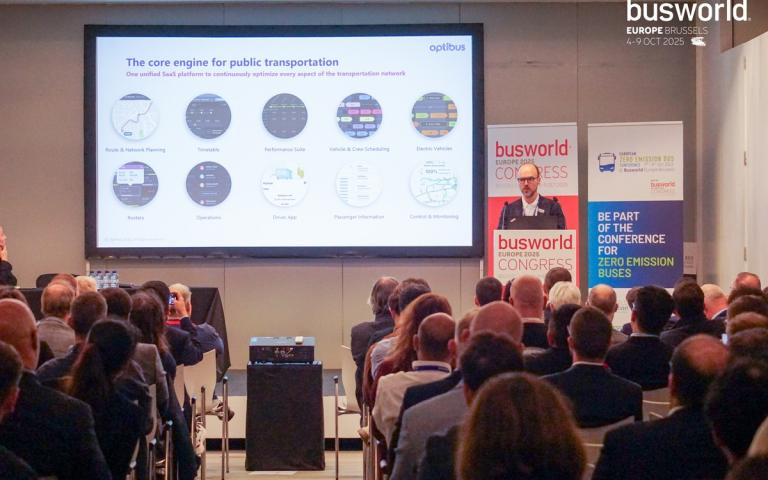
Following the Busworld Europe 2025 Congress, the official Socio-Economic Insights Report on the European bus and coach industry has been released.
The report offers a comprehensive overview of the sector’s current trajectory and future challenges and identifies several key trends shaping the industry. Globally, the bus and coach market is expected to grow significantly, reaching 336,000 units annually by 2030. Within Europe, established manufacturers such as Daimler, Iveco and MAN Truck & Bus continue to hold leading positions.
A central conclusion of the report is that Europe must improve alignment across regulation, funding, infrastructure development and industrial policy if it is to meet its 2030 decarbonisation targets. While the transition to zero-emission mobility is well underway, progress remains uneven and constrained by infrastructure gaps, grid capacity limitations and financial pressures.
Europe’s bus and coach sector is undergoing a profound transformation, with an irreversible shift to zero-emission transport colliding with rising costs, infrastructure gaps and a deepening driver shortage.
The findings paint a picture of an industry that continues to grow globally but is under increasing strain in Europe, where operators must balance climate targets, financial sustainability and service continuity.
Global Growth Masks European Pressures
Worldwide demand for buses and coaches remains strong, with 261,000 units expected in 2025, rising to around 336,000 annually by 2030. China continues to dominate the market, accounting for roughly half of global demand, while Europe’s share is projected at about 40,000 units.
Despite this growth, the European market is facing tighter margins and structural change. Manufacturers such as Daimler and Iveco currently hold leading positions, but the competitive landscape is shifting as electrification accelerates.
The report makes clear that the transition to zero-emission buses is well underway and “irreversible.” In urban networks, electrification is advancing rapidly, with battery-electric buses already overtaking diesel sales.
By 2030, zero-emission vehicles are expected to account for around 74–75% of the European market. However, this still falls short of the EU’s 90% target for city buses, highlighting a significant implementation gap.
Key barriers include:
- Limited charging infrastructure
- Slow expansion of electricity grids
- High upfront vehicle costs
- Inconsistent funding across member states
While some countries are close to full electrification, others lag behind, dragging down overall progress.
For long-distance coach services, the challenge is even greater. Longer routes, higher energy demands and limited infrastructure mean diesel is still expected to dominate this segment by the end of the decade, with alternative technologies such as hydrogen remaining costly and underdeveloped.
Funding Gaps and Rising Costs
Public transport systems across Europe are facing a widening financial gap. On average, fare revenues cover just 44% of operating costs, with the remainder reliant on public subsidies and other funding streams.
Ticket prices are often politically determined rather than economically driven, limiting revenue growth. At the same time, the transition to electrification is increasing capital costs.
The report points to a need for more stable and diversified funding models, including:
- Earmarked taxes (such as payroll or tourism levies)
- Congestion charging and road pricing
- Private sector contributions
Without reform, the combination of rising costs and constrained public budgets risks undermining service levels.
Tendering Systems
Procurement and contracting models are also under pressure. The report highlights that traditional tendering systems are struggling to cope with technological disruption, inflation and investment risk.
More flexible, long-term contracts are increasingly seen as essential. The report emphasises:
- Better risk-sharing between public transport authorities and operators
- Longer contract durations aligned with asset lifecycles
- Clearer and more realistic sustainability requirements
Countries such as Sweden are cited as examples of more stable, collaborative tendering models.
Supply Chain Risks
As demand for electric buses grows, supply chain vulnerabilities are becoming more apparent. Europe remains heavily dependent on external suppliers—particularly in China—for battery production and raw materials.
Efforts to impose strict local sourcing or low-risk supply requirements too quickly could backfire, potentially increasing costs by up to 30–40% and delaying deliveries.
Operators are also placing significant demands on manufacturers, including long battery warranties and extended vehicle lifespans, shifting financial risk onto suppliers and complicating project financing.
Driver Shortage
Alongside financial and technological challenges, the sector faces a critical workforce issue. Around 105,000 driver positions are currently unfilled across Europe—roughly 10% of the workforce.
With an ageing workforce and low levels of young and female entrants, the shortage could reach 275,000 drivers by 2028.
The causes are wide-ranging:
- Poor work-life balance
- Relatively low pay in some regions
- Limited diversity and outdated industry image
- High early attrition rates among new recruits
Some operators report that up to a quarter of new drivers leave within their first year.
Proposed solutions include improving working conditions, expanding training pathways, increasing female participation and enabling recruitment from outside the EU.
Read more about the discussion on driver shortages here.
Across all areas, the report highlights a central challenge: misalignment between policy ambition and practical implementation.
While regulation has driven rapid progress in vehicle technology, supporting systems, such as infrastructure, funding and workforce development, have not kept pace.
The congress concludes that the sector needs:
- Stronger coordination between EU and national policies
- Faster infrastructure deployment
- More realistic and standardised procurement frameworks
- Long-term financial stability
Without these changes, Europe risks falling short of its climate goals while placing additional strain on already stretched public transport systems.
Download the full report for more detailed information here.