Alexander Dennis has called on the Scottish and UK governments to establish a long-term pipeline of bus orders for domestic manufacturers, arguing that changes to Scottish Government funding have affected its plans to resume bus production at its Scottish facilities.
The British bus manufacturer, a subsidiary of NFI Group, issued the statement in response to a ministerial announcement, noting that the company had failed to meet the conditions for receiving up to 4.1 million GBP in furlough support.
The government’s conditions included retaining manufacturing jobs and securing orders for buses to be built in Scotland. Alexander Dennis argues that the cancellation of additional ScotZEB2 funding and the subsequent ScotZEB3 process changed the expected order pipeline, prompting it to adapt its Larbert facility for chassis production.
In June 2025, Alexander Dennis announced plans to cease bus manufacturing at its two Scottish sites, citing falling demand and international competition. It subsequently agreed to a 26-week furlough scheme following the Scottish Government’s announcement of an additional 40 million GBP for the second phase of its Scottish Zero Emission Bus Challenge Fund (ScotZEB2).
Alexander Dennis expected the funding to generate sufficient orders for production to resume in 2026, with furlough payments intended to cover 80% of affected employees’ wages while the company awaited new orders.
This has fuelled ongoing criticism about the use of government funds to support overseas manufacturing capabilities, at the detriment of domestic manufacturing. Read more about this issue and what can be done to mitigate it here, or check out our Podcast discussion.
However, the additional ScotZEB2 funding extension was cancelled and replaced by the ScotZEB3 funding competition. Alexander Dennis said this changed the expected order pipeline on which the original furlough arrangements had been based.
As the company anticipated lower order volumes through ScotZEB3, it began considering options to retain viable manufacturing operations in Scotland, including bringing chassis production in-house. The company said it outlined this approach to Scotland’s Deputy First Minister in March 2026.
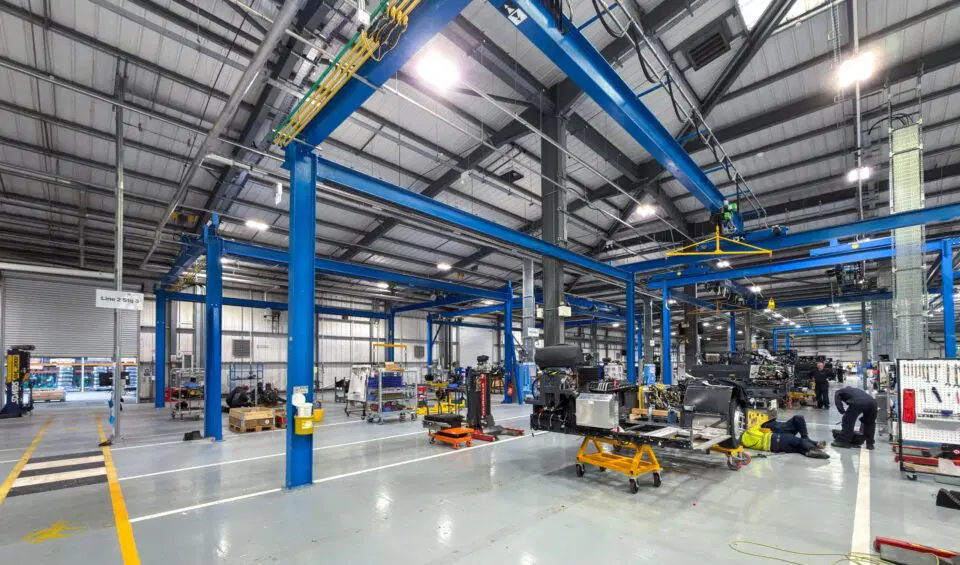
When the ScotZEB3 results were announced that month, more than half of the buses funded were awarded to overseas manufacturers. Alexander Dennis subsequently consulted on proposals to make chassis assembly the only commercially viable manufacturing activity at its Scottish operations. The company invested millions of pounds in transforming its Larbert facility, in addition to investments made at the site in 2023. It said the spending was intended to retain skilled jobs and manufacturing capabilities in Scotland. Meanwhile, it announced the closure of its legacy bus body manufacturing plant in Falkirk.
Meanwhile, Alexander Dennis rejected the suggestion that its manufacturing changes reflected a predetermined plan to close its Scottish operations. It also argued that the costs it had incurred to protect jobs and skills exceeded the 4.1 million GBP in furlough support originally offered.
The company said it had retained the capability to resume full bus body manufacturing if future demand justified the investment.
Paul Davies, President & Managing Director at Alexander Dennis said:The suggestion that the furlough scheme failed because Alexander Dennis did not meet the agreed conditions tells only part of the story.
“In summer 2025, the Scottish Government announced additional ScotZEB funding that was expected to generate hundreds of bus orders for Alexander Dennis and safeguard manufacturing jobs in Scotland. It was on that basis that we reversed plans to close our Falkirk and Larbert factories, with expectations that the furlough payments would cover 80% of affected staff wages until new bus orders materialised.
Any fair assessment of the situation will recognise that the withdrawal of the additional ScotZEB2 funding created an orderbook shortfall that ultimately led to our move to adapt Larbert to a chassis manufacturing facility.
Alexander Dennis has invested millions of pounds of its own capital to safeguard jobs and manufacturing capability in Scotland. We are currently producing high-quality bus chassis in a state-of-the-art facility that we are all proud of and we have deliberately retained the ability to return to full bus body manufacturing if future demand supports it.
Today, Scotland’s only domestic bus manufacturer has spare capacity while Scottish taxpayers’ money continues to subsidise buses built overseas.
If the UK and Scottish governments create a stable, long-term pipeline of orders for domestically built zero-emission buses, Alexander Dennis is ready to invest, grow and reinstate bus body manufacturing in the region.
The company is now calling for closer cooperation between government and industry to provide manufacturers with greater certainty over future demand. It argues that sustained orders would support domestic production, skilled employment and economic growth.
Alexander Dennis said it remained able to expand its Scottish manufacturing operations if sufficient demand materialised.
Wrightbus, now the leading UK bus manufacturer, has also acknowledged the threat of overseas manufacturers and called for the government to do more to support domestic jobs and supply chains.