Daimler Buses has unveiled a near-production prototype of the next-generation Mercedes-Benz eCitaro, with the new electric city bus scheduled to launch in Europe in 2028.
Lead development of the vehicle will be handled in Mannheim, Germany, with additional production duties planned across Germany, France and the Czech Republic.
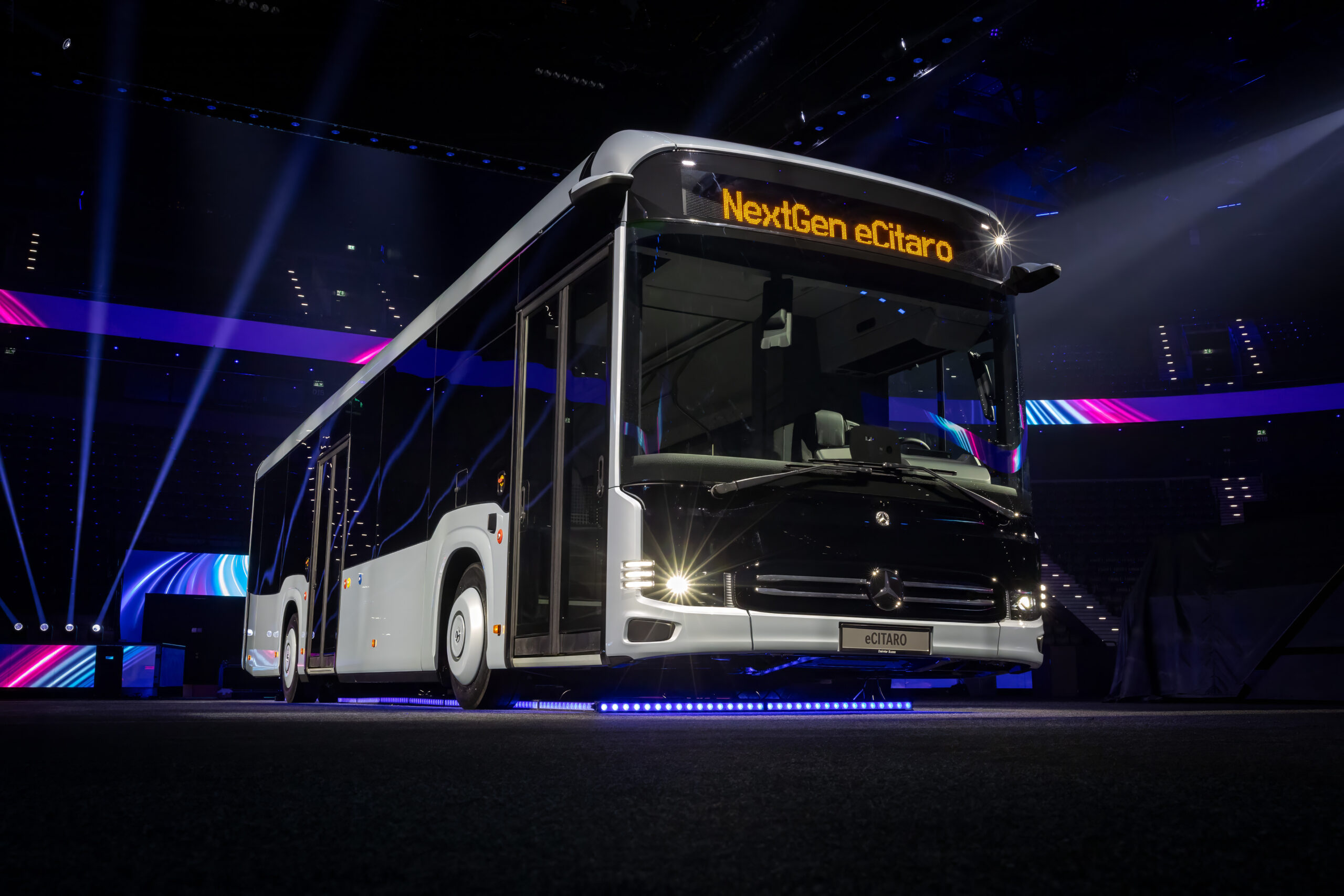
The vehicle was presented at the Daimler Buses eMobility Days in Munich, during which the company also shared its views on both the political and regulatory framework needed to support the transition as a whole.
Unlike the current eCitaro, which is based on the conventional Citaro platform, this next generation vehicle has been developed specifically as an electric vehicle. It will use lithium iron phosphate (LFP) battery technology, with solo buses accommodating six to 12 battery packs and articulated versions eight to 14, depending on vehicle length and operating requirements.
Two drive configurations will be available, with the low-floor version using motors positioned close to the wheels, creating a level passenger compartment throughout the vehicle and allowing articulated models to operate with just one driven axle, whilst the low-entry version features a central motor, enabling speeds of up to 100 km/h – rendering it more suited for intercity services.
The electric-specific design of the vehicle is also intended to also reduce its overall weight, with the articulated version approximately 750kg lighter than its predecessor, and a new electronic architecture providing over-the-air software update support, as well as the activation of additional functions after purchase.
European Trends in Electric Vehicles
Introduction of the new model forms part of the manufacturer’s wider electrification strategy, which aims to see Daimler Buses offer exclusively electrically powered city buses in its European new-vehicle business from 2030. However, the company has stated that achieving this ambition will rely on consistent European legislation, continued government funding and faster investment in public charging infrastructure.
Till Oberwörder, CEO of Daimler Buses, said:We are clearly committed to Germany and Europe as business locations: This is where we are developing and producing the next generation of our electric city bus. Europe has the expertise and the industrial base for the mobility of the future.
The EU must create the right conditions to ensure that industrial value creation here remains competitive. To achieve this, we need simple and consistent rules across national borders, without exceptions. And we need them now, not in the next decade.
Daimler Buses has stated that whilst it supports the EU’s proposed Industrial Accelerator Act, which seeks to strengthen European industrial production as well as increase demand for low-CO₂ products manufactured within the region, the company has also warned that legislation must avoid introducing complex additional requirements for manufacturers or creating uncertainty through lengthy approval processes.
In 2025, electric vehicles accounted for two-thirds of European city buses sold – a figure Daimler Buses believes it has contributed to through the delivery of more than 4,600 Mercedes-Benz eCitaro vehicles since its introduction in 2018.
With Government funding having played a key role in the region’s transition to electric vehicles, Daimler Buses has stated that it has concerns related to proposed reductions to electric bus funding in Germany from 2027 onward, and has called for financial support to continue at its current level.
Infrastructure Challenges
With this new generation vehicle; Daimler Buses is looking to extend electrification beyond city buses. Its battery-electric Mercedes-Benz eIntouro intercity bus, which was unveiled in late 2025, offers a range of up to 500km, with the first customer delivery scheduled for November 2026. The vehicle is designed for intercity routes, school transport, shuttles and excursions.
Elsewhere, battery-electric coaches are planned by the end of the decade, followed by fuel-cell coaches in a subsequent development phase. However, the company has warned that intercity buses and coaches depend heavily on public charging infrastructure – unlike city buses that can generally charge at operator depots.
Industry association ACEA estimates Europe will need around 35,000 heavy-duty vehicle charging points along major transport corridors by 2030, alongside more than 14,000 additional points for buses. Daimler Buses has argued that charging facilities must also be installed near tourist destinations, where coaches regularly operate away from major highways.
Realistic Emission Expectations
Whilst Daimler Buses has stated that it supports the EU requirement for 90% of newly sold city buses to be CO₂-neutral from 2030, the company also believes that the targets for intercity buses and coaches need further consideration.
With these vehicles facing a requirement to reduce CO₂ emissions by 43% from 2030 compared with the 2025/2026 reference period; Daimler Buses has argued that the necessary charging infrastructure is at least three years behind schedule and that operators may struggle to make the transition economically viable. The company has therefore called for the EU to link its emissions targets to tangible infrastructure progress and postpone the 2030 deadline for intercity buses and coaches until 2033.
Till Oberwörder, CEO of Daimler Buses, said:We support ambitious CO₂e targets in Europe. What matters is that the framework conditions are in place to support them. Our vehicles will be available in time, but the necessary public charging infrastructure most likely will not. Without it, our customers cannot operate the vehicles economically. Building this infrastructure is not the responsibility of vehicle manufacturers.
Anyone setting targets must also create the conditions needed to make them achievable. Otherwise, the transformation will become a competitive disadvantage for European industry.
In order to help address the infrastructure gap, Daimler Buses subsidiary Daimler Buses Solutions plans to develop and operate public charging stations at key transport hubs, with initial projects are already underway in Hamburg, Cologne and Munich.