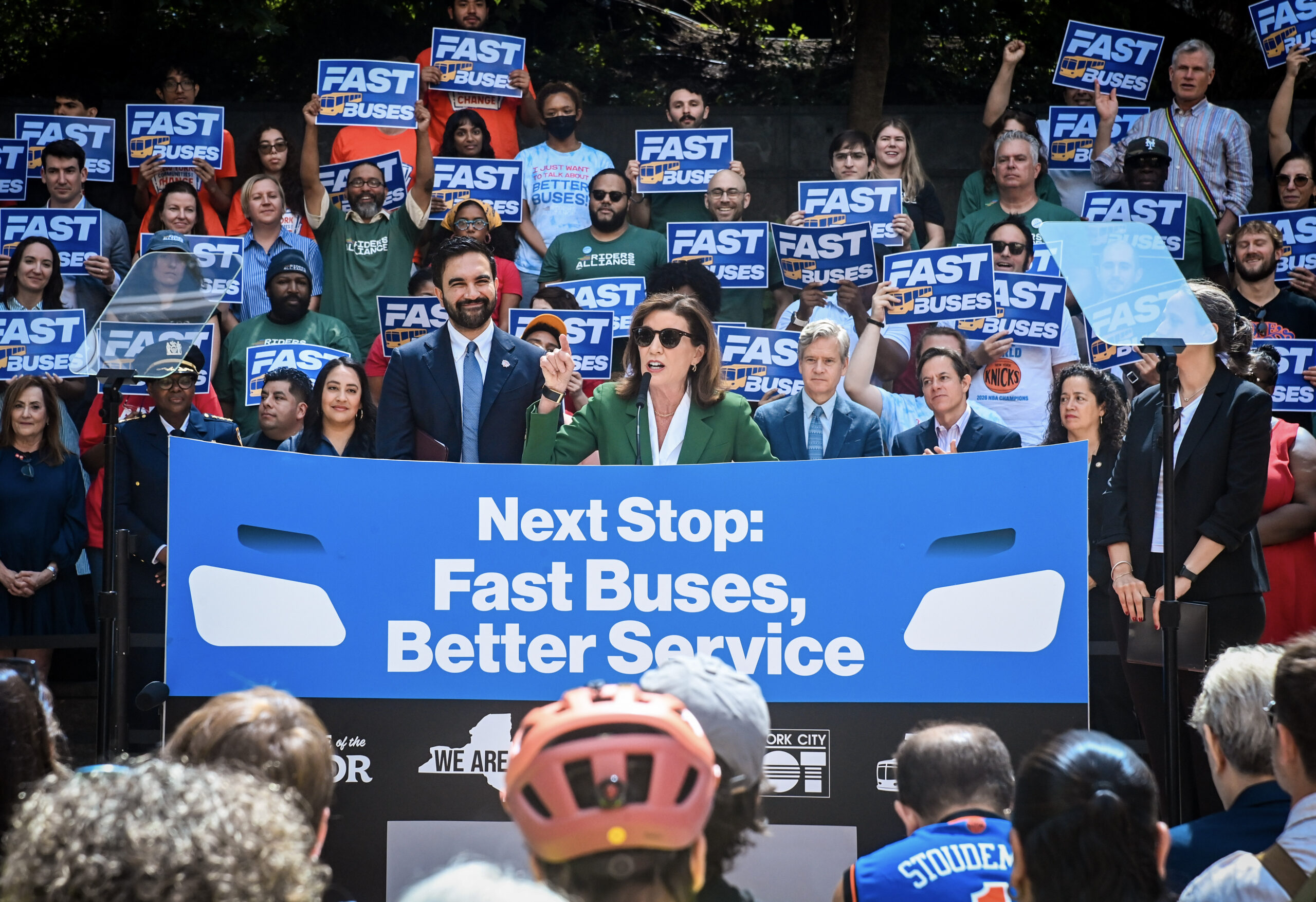
New York Governor Kathy Hochul and New York City Mayor Zohran Mamdani have announced a joint strategy to improve bus services across the city. Measures include new priority corridors, expanded bus lane enforcement, fleet renewal and the introduction of all-door boarding.
The plan, titled Next Stop: Fast Buses, Better Service, has been developed by the New York City Department of Transportation (NYC DOT) and the Metropolitan Transportation Authority (MTA). It identifies 50 bus corridors across the city’s five boroughs where infrastructure and operational improvements will be prioritised.
Work on the first corridors is scheduled to begin this year, with five routes selected for the initial phase of a next-generation rapid bus network. These include Tremont/Cross Bronx in the Bronx, Northern Boulevard in Queens, Flatbush Avenue and Utica Avenue in Brooklyn, and the Kensington–JFK corridor linking Brooklyn and Queens.
The rapid bus corridors will feature dedicated and protected bus lanes, upgraded waiting areas, improved public spaces and frequent all-day services. The Flatbush Avenue route is expected to be completed by 2030.
The MTA will also introduce all-door boarding across the network in 2027 following the full transition to contactless fare payment. The change is intended to reduce dwell times at bus stops and improve journey reliability.
As part of the MTA’s 2025–2029 capital programme, approximately 2,500 new buses will be purchased, replacing around 40 percent of the authority’s existing fleet. The programme also includes measures to improve vehicle maintenance and depot operations to increase service reliability.
Passenger facilities will also be upgraded. NYC DOT and the MTA plan to install 300 new bus shelters by 2028, add seating at around 875 bus stops each year, expand accessibility improvements to 65 stops annually by 2030 and deploy almost 2,900 real-time passenger information displays across the network by the end of the decade.
The plan also proposes further expansion of bus lane enforcement. Bus-mounted automated enforcement cameras will be introduced on an additional 25 routes in both 2026 and 2027, while 200 new fixed bus lane cameras are due to be installed by 2027. The New York Police Department will increase targeted bus lane enforcement from 14 to 20 corridors from 2026.
MTA Chair and CEO Janno Lieber said:For years, we at MTA have wanted more bus lanes, more enforcement of cars and trucks blocking bus lanes. Faster buses. Congestion pricing. But it’s no secret we didn’t have support at the local level. That is not the case anymore. Our partners today — this Governor, this Mayor and this NYC DOT — all want to make sure that riding the bus is always faster than walking. They want to follow through on long overdue commitments to build bus lanes and busways. They will ramp up traffic enforcement to keep streets moving. Buses can only move as fast as traffic allows, so if you are a bus or a bus rider this is terrific news.
New York City’s bus network carries approximately 2.75 million passenger journeys each day. Despite having the largest bus system in the US, average operating speeds remain around 8mph, making it one of the slowest major urban bus networks in the country.
Governor Hochul said:Every day, millions of New Yorkers rely on buses to get around this city, but for far too long, making their journeys faster and their lives easier has seemed out of reach. That all changes today. New York is in the midst of a transit renaissance, with historic investments being made to improve the lifeblood of our city. Now, working with Mayor Mamdani, we are advancing a bold and ambitious plan to move buses faster, dramatically expand bus priority, reduce delays and make our bus system the envy of the world.
Before construction begins on individual schemes, NYC DOT and the MTA will undertake community engagement activities, including public events, surveys and consultation with local organisations. Performance data covering journey times, reliability and passenger experience will be published between six and 12 months after projects are completed to assess the impact of the improvements.