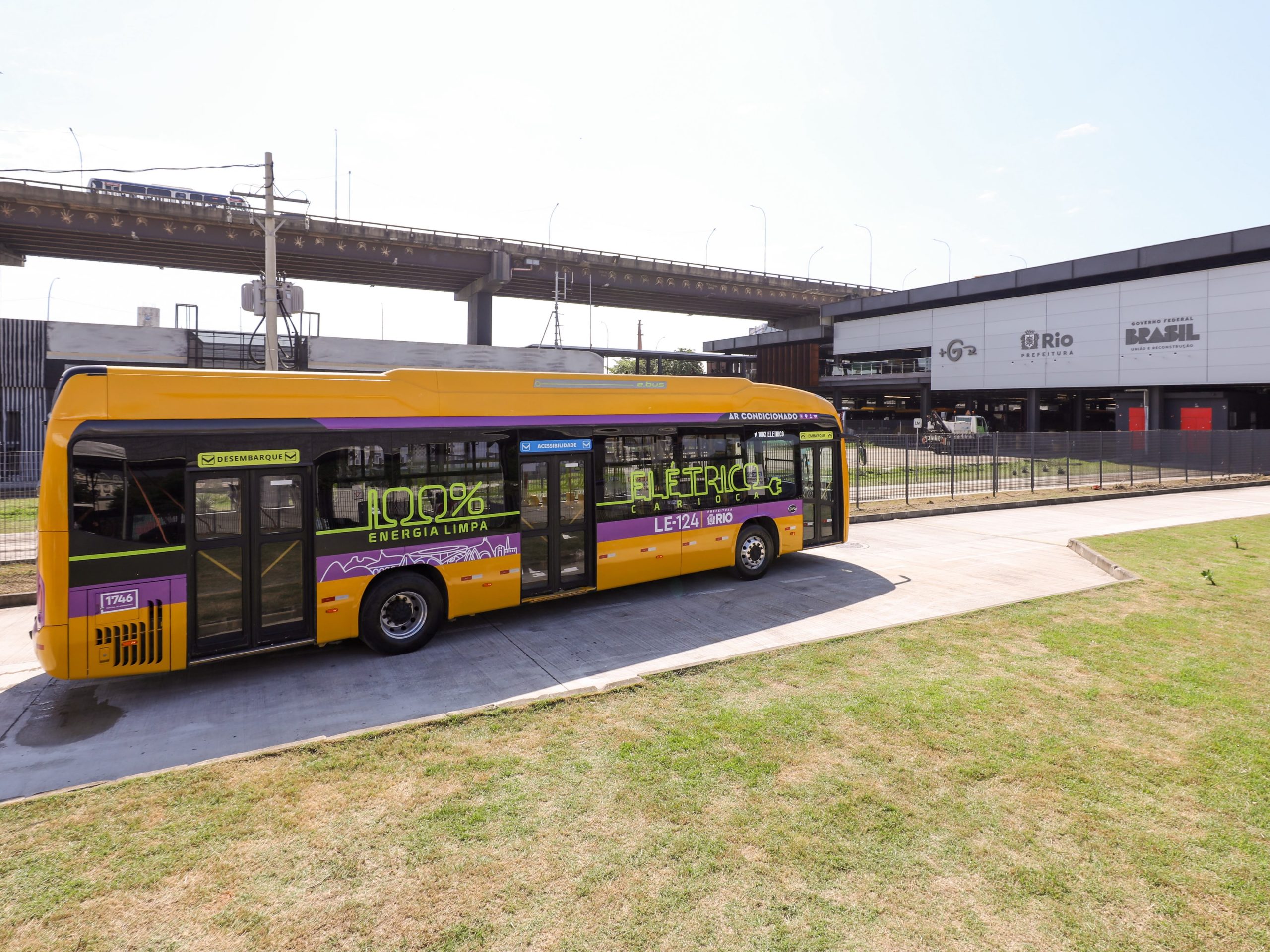
Rio de Janeiro City Hall has announced financing of 329 million BRL from BNDES in order to enable the first public-private partnership (PPP) for electric buses in Brazil.
Announced at the Gentileza Terminal, the project, which will be delivered through the Climate Fund, will receive a total planned investment of 509 BRL, and will include the acquisition of 175 vehicles, which will be gradually integrated into the RIO System during the second half of 2027.
Additionally, the project will also see the construction of a new public garage in Maré, which will be fully equipped with all necessary charging infrastructure for the vehicles, and be located on Rua Novo Horizonte in Vila do João, in front of the Oswaldo Cruz Foundation on Avenida Brasil.
This site will span around 41 square metres, of which roughly 23 m² will be dedicated to the electric parking garage. The project will include areas for parking, maintenance, administration, storage, and electrical charging infrastructure.
Mayor Eduardo Cavaliere, said:These 175 buses that will electrify the entire fleet operating at the Gentileza Terminal are another step in the transformation of the city's bus transportation. There will also be a change in the fuel used by the buses circulating in the city to less polluting biofuels. Thus, we will modernize the fleet, combining electrification and biofuels to have a greener public transportation system.
The initiative will be delivered through an administrative public-private partnership (PPP) over the course of a 16-year contract, which is comprised of one year of implementation and 15 subsequent years of operation. The concessionaire will ultimately be responsible for the partial acquisition of the vehicles, implementation of the charging infrastructure, garage construction, operation, and maintenance of the assets.
Once introduced into service, the new buses are expected to prevent the release of nearly 13.3 tonnes of carbon dioxide (CO₂) equivalent per year, reaching approximately 199.4 tons over the 16 years stipulated in the contract whilst also reducing local pollutant emissions and overall noise pollution.
The new Rio Electric System Lot forms part of a municipal strategy to increase the participation of zero-emission vehicles in public transportation, with the goal set out in the Sustainable Development Plan aiming to transition 20% of the municipal fleet to zero-emission vehicles by 2030 – the equivalent to approximately 1,000 buses.
Funding for the project is aligned with the Federal Government’s policy of electrification and decarbonisation of public transportation, and resources will be made available by BNDES through the Climate Fund, which supports projects aimed at reducing greenhouse gas emissions and provides for investments in sustainable urban mobility. In Rio, this funding will enable the acquisition of 175 electric buses, which will contribute to the modernisation of the municipal fleet and the reduction of emissions in the city’s public transportation.
Overall, the operation of the first electric parking garage is expected to involve around 490 drivers, 35 inspectors, and 10 dispatchers, in addition to maintenance and administrative teams, and the implementation of wider infrastructure is estimated to generate around 100 jobs related to construction, charger installation, electrical upgrades, engineering, vehicle and equipment manufacturing, and system testing.