The 20-Second Rule: Measuring Escape in Modern Bus Safety
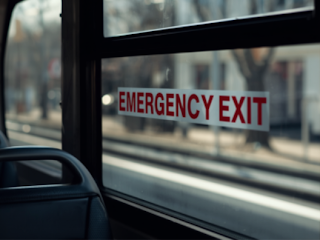
Transport safety regulations are increasingly shifting from theoretical compliance toward measurable survivability. UNECE Regulation No. 107 Rev.10 reflects this transition through one particularly significant requirement: emergency glazing systems must be capable of being broken and removed within 20 seconds by a single passenger from inside the vehicle.

This requirement fundamentally changes how emergency evacuation systems are evaluated. Historically, many transport safety systems were assessed primarily by equipment presence and design compliance. The revised regulation instead focuses on operational performance under real emergency conditions.
The 20-second requirement reflects the realities of smoke development, fire escalation and passenger panic during emergencies. In evacuation scenarios, time becomes a critical safety variable. Delays of only seconds can significantly reduce survivability, particularly within enclosed passenger environments where heat, smoke and crowd movement intensify rapidly.
The regulation therefore treats emergency egress as an operational outcome rather than a passive design feature. Passengers must not only have access to emergency systems, but must realistically be capable of using them quickly under degraded conditions.
This shift aligns with broader resilience-based engineering principles reflected in ISO 26262-1:2018, which emphasises maintaining safe outcomes during failure conditions. Within increasingly complex transport systems, survivability increasingly depends on how rapidly passengers can evacuate when primary systems become compromised.
The amendments also reinforce the importance of intuitive operation during emergencies. Escape systems must remain visible, accessible and immediately operable under stress conditions involving confusion, limited visibility and physical disorientation.
Mechanical emergency egress systems such as Safe-T-Punch™ align naturally with this resilience-focused approach because they provide immediate physical operation without dependence on electronic activation or power availability. Their operation remains consistent during smoke conditions, electrical failure or infrastructure disruption.
For bus operators and manufacturers, emergency evacuation capability is increasingly being evaluated by how rapidly passengers can physically escape when conditions deteriorate.
This article was originally written by Safe-T-Punch.