Traditional transport safety models have historically focused heavily on accident prevention. Vehicle stability systems, driver-assistance technologies, collision mitigation platforms and operational controls were primarily designed to reduce the likelihood of incidents occurring. While prevention remains critical, modern transport safety engineering is increasingly recognising another reality: not all emergencies can be avoided.
As public transport systems become more complex and interconnected, regulators and manufacturers are placing growing emphasis on survivability during failure conditions. This represents an important evolution in safety philosophy. The question is no longer only how to prevent emergencies, but also how to ensure passengers can survive when prevention systems fail.
UNECE Regulation No. 107 Rev.10 reflects this transition clearly through strengthened emergency evacuation requirements governing M2 and M3 passenger vehicles. The amendments place increased focus on emergency egress accessibility, operational reliability and measurable evacuation capability under degraded conditions.
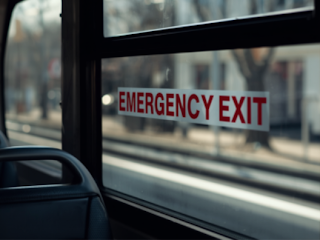
One of the most significant aspects of the regulation is its recognition that emergency systems must remain usable during realistic crisis environments involving smoke, panic, electrical disruption or infrastructure failure. Emergency evacuation capability is increasingly treated as an operational survivability outcome rather than a passive compliance feature.
This broader resilience philosophy also aligns closely with principles reflected in ISO 26262-1:2018, which emphasises maintaining safe outcomes during electrical or electronic systems failures. Within increasingly digitised transport environments, maintaining independent emergency functionality becomes increasingly important for passenger survivability.
For bus operators and manufacturers, this creates an important engineering priority. Safety systems must continue functioning under worst-case conditions rather than relying entirely on normal operating assumptions. Emergency escape systems therefore become a critical final layer within broader transport resilience frameworks.
Mechanical emergency egress systems such as Safe-T-Punch™ support this survivability-focused approach because they remain operational independently of software logic, network infrastructure or electrical functionality. Their direct physical operation preserves evacuation capability even when primary systems become compromised.
As public transport systems continue evolving technologically, the future of transport safety increasingly depends not only on preventing emergencies, but on ensuring passengers retain a dependable means of escape when prevention alone is no longer enough.
This article was originally published by Safe-T-Punch.