Why Human Factors Still Define Emergency Bus Safety
Modern bus safety systems are becoming increasingly sophisticated. Electronic monitoring platforms, automated diagnostics and digitally integrated operational systems now form part of everyday public transport infrastructure. Yet during emergencies, passenger survivability is still heavily influenced by one variable technology cannot eliminate: human behaviour under stress.

Emergency evacuation environments are rarely orderly. Smoke, noise, panic, disorientation and restricted visibility can rapidly impair passenger decision-making and response times. In these conditions, emergency systems that appear effective under controlled testing environments may become difficult to identify or operate during real-world emergencies.
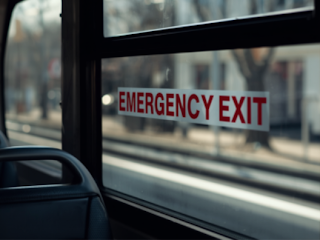
UNECE Regulation No. 107 Rev.10 reflects growing recognition of these challenges through strengthened requirements surrounding emergency egress accessibility and usability. Emergency devices must remain clearly visible, positioned on escape points and capable of rapid operation by passengers under degraded conditions. The regulation increasingly treats evacuation as a human-centred operational process rather than a purely technical compliance exercise.
This represents an important shift in transport safety philosophy. Safety systems must not only function mechanically or electronically but must also remain understandable and usable under psychological stress. Emergency design increasingly depends on reducing complexity during moments of panic.
The direction of these amendments also aligns with principles reflected in ISO 26262-1:2018, which emphasises maintaining safe outcomes during system failures and abnormal operating conditions. Within highly digitised transport environments, human factors engineering becomes increasingly important because passengers may need to respond rapidly during situations involving electrical faults, smoke conditions or systems disruption.
For bus operators and manufacturers, this reinforces the importance of intuitive emergency system design. Emergency escape capability must remain simple, visible and immediately actionable regardless of environmental conditions.
Mechanical emergency egress systems such as Safe-T-Punch™ support this resilience-based approach because they provide direct physical operation without dependence on software navigation, electronic activation sequences or power availability. Their simplicity reduces operational uncertainty during high-stress evacuation scenarios, preserving immediate escape capability when passengers may already be experiencing confusion or disorientation.
As public transport systems become more technologically advanced, emergency survivability still depends heavily on designing systems that accommodate human behaviour under extreme conditions.
This article was originally written by Safe-T-Punch.