An airport apron bus should never force an operator to choose between passenger escape and airside security. Yet a removable emergency hammer can create exactly that tension.
If the hammer is missing, passengers may lose the intended means of breaking a toughened-glass emergency exit when the normal doors cannot be used. If the hammer has been removed from the vehicle, the same portable object may also create a security-control issue inside a restricted airport environment. The problem is therefore not whether glass-breaking equipment should be provided. It is whether emergency egress should depend on a loose tool that can disappear from the point of escape.
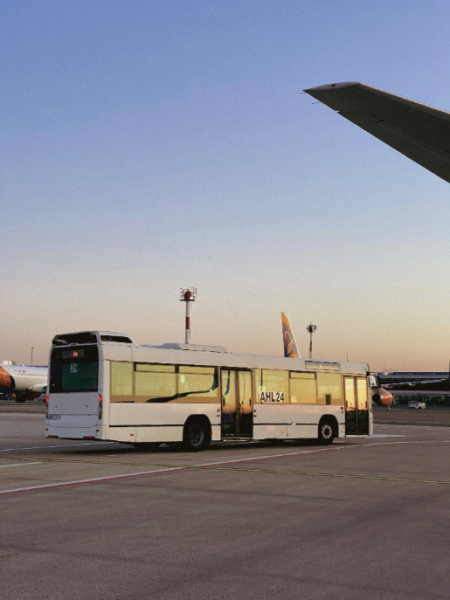
This matters particularly on airport aprons. Apron buses operate inside tightly controlled environments where passenger movement, vehicles, aircraft and security procedures intersect. Under European aviation security rules, security restricted areas include parts of an airport used for boarding, loading and aircraft parking, and access to those areas is controlled. Persons other than passengers may not carry prohibited articles into security restricted areas unless specifically authorised for essential operational tasks.
Those rules do not name an emergency hammer specifically. They do, however, recognise that articles capable of causing serious injury can require security control. This means a removable hammer that leaves the bus can create a different risk profile from the same device when it remains secured as part of the vehicle. The exact treatment will depend on the airport, jurisdiction and operator security programme, but the underlying security question is legitimate: why allow emergency equipment to become a portable object if its function is required at one fixed location?
The passenger-safety side of the problem is equally direct. A loose hammer can be misplaced, removed, vandalised, damaged or relocated during cleaning and maintenance. The emergency window may remain clearly marked while the device intended to create the escape opening is no longer present. In a collision, fire or other event where the main doors are blocked or inaccessible, that missing tool becomes an egress failure rather than a housekeeping issue.
UNECE Regulation No. 107 reinforces the importance of continuous availability for emergency-window devices on M2 and M3 vehicles. Under the amended requirements, a glass-breaking device must be clearly visible and readily available at all times. The regulation allows a device to be permanently fixed adjacent to or on each emergency window, or alternatively requires a warning to the driver when a removable device is no longer in its designated location. For electronic devices, operation must also be maintained during vehicle power failure.
That regulatory logic is particularly relevant to apron buses even where the exact legal application of UNECE R107 depends on vehicle category, jurisdiction and approval pathway. It recognises that emergency equipment should not be assumed available simply because it was fitted when the vehicle entered service. Availability itself is part of emergency performance.
Safe-T-Punch™ applies that principle physically. It is a fixed, visible mechanical emergency glass-breaking device designed for R43 toughened safety glass and mounted directly on the emergency-exit window. Because the means of initiating glass fracture remains at the point of escape, passengers do not have to search the vehicle for a separate tool, and inspection personnel can visually confirm that the emergency device remains installed where it is intended to operate.
This reduces two forms of uncertainty at once. From the passenger-safety perspective, the device remains available at the emergency window. From the airside-security perspective, the glass-breaking capability remains part of the vehicle rather than becoming a portable object capable of moving through a restricted environment.
Airport operators should not have to trade reliable emergency escape against effective airside security. The stronger design principle is to satisfy both: keep the means of escape fixed, visible and ready exactly where it is required.
Sources And Further Reading
- UNECE – ECE/TRANS/WP.29/2022/53: amendments to UN Regulation No. 107
Primary source for emergency-window device visibility, continuous availability, permanent fixing adjacent to or on the emergency window, and power-failure provisions for electronic devices. - UNECE – UN Regulation No. 107: General construction of buses and coaches
UNECE regulatory index for the current published revisions and amendments to UN Regulation No. 107. - European Commission / EUR-Lex – Commission Implementing Regulation (EU) 2015/1998
Primary EU aviation-security source for security restricted areas, controlled access, prohibited articles and authorised operational exceptions. - Safe-T-Punch™ – Emergency Window Escape Devices
Product source describing Safe-T-Punch™ as a fixed emergency escape device designed to break automotive R43 toughened safety glass.
This article was originally published by Safe-T-Punch.