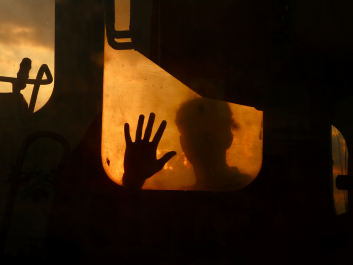
Modern transport glazing is designed to protect passengers during collisions and rollover events. But emergency glazing has to satisfy another requirement entirely: when a window becomes an emergency exit, passenger protection must be balanced with the ability to create a usable escape opening.
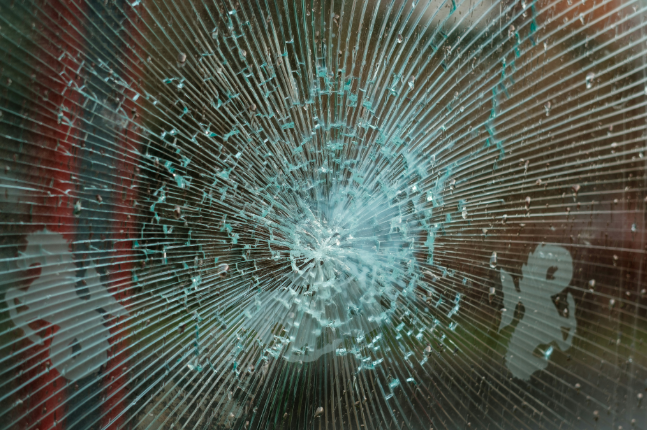
That distinction matters because toughened and laminated safety glass behave differently.
UN Regulation No. 43 defines toughened glass as a single layer that has been specially treated to increase its mechanical strength and control its fragmentation after shattering. Laminated glass, by contrast, consists of two or more layers of glass held together by one or more plastic interlayers.
Those differences are directly recognised in the emergency-window provisions introduced through amendments to UNECE Regulation No. 107 for M2 and M3 passenger vehicles.
The regulation provides two distinct routes for an emergency window. One allows a window to be easily and instantaneously operated by a satisfactory device, including the possibility of laminated glass or plastic glazing. The other specifically concerns toughened-glass panes.
For the toughened-glass route, an easy-to-operate device must ensure that each pane can be broken and removed within 20 seconds by a single person from inside the passenger compartment. The Technical Service verifies this by testing the device and measuring the period from the first action until the required free emergency opening has been achieved.
This is an important distinction for emergency-egress engineering.
Glazing should not be considered independently from the mechanism through which passengers are expected to escape. The glass type, emergency device, its location and the required escape opening form a connected safety system.
That principle becomes increasingly important as buses incorporate more electrical and electronic systems. The ISO 26262 functional-safety framework addresses hazards caused by malfunctioning behaviour of safety-related electrical and electronic systems in road vehicles. It provides useful context for a broader resilience principle: critical safety outcomes should be considered in relation to the dependencies capable of affecting them.
Safe-T-Punch™ applies that principle physically within the R43 toughened-glass emergency-window pathway. Mounted directly on the emergency exit window, it provides a fixed mechanical means of initiating glass fracture without requiring software logic, network connectivity or vehicle power.
The wider lesson is simple.
Emergency glazing is not only about how well a window protects passengers while they are inside the vehicle. It is also about how reliably that window can become an escape route when remaining inside is the greater danger.
Sources and Further Reading
UNECE Regulation No. 107 amendment – ECE/TRANS/WP.29/2022/53
Primary regulatory source for the amended emergency-window requirements, including the distinction between laminated/plastic glazing and toughened-glass emergency windows and the 20-second performance requirement.
https://unece.org/sites/default/files/2022-02/ECE_TRANS_WP.29_2022_53E.pdf
UN Regulation No. 43 – Safety Glazing Materials
Primary regulatory reference for the definitions and technical treatment of toughened and laminated safety glazing.
https://unece.org/fileadmin/DAM/trans/main/wp29/wp29regs/2017/R043r4e.pdf
ISO 26262-1:2018 – Road vehicles – Functional safety – Part 1: Vocabulary
ISO source for the vocabulary used throughout the ISO 26262 functional-safety series.
https://www.iso.org/standard/68383.html
Safe-T-Punch™
Product information and emergency-egress application context.
https://safe-t-punch.co.za/
This article was originally published by Safe-T-Punch.